The Five Heritage Risks That Derail Mining Projects.
Most mining risk registers treat cultural heritage as a permitting item. It is a lifecycle risk, and the points where it surfaces are predictable.
By Neil Fairburn · Director, Cultural Heritage Risk Management Ltd
Most mining project risk registers treat cultural heritage as a Phase 1 permitting item. That is the first mistake. Heritage risk does not stop when you receive your permit. It compounds across the mine lifecycle, and the points where it surfaces are predictable. After thirty years working across mining and major infrastructure internationally, these are the five I see repeatedly.
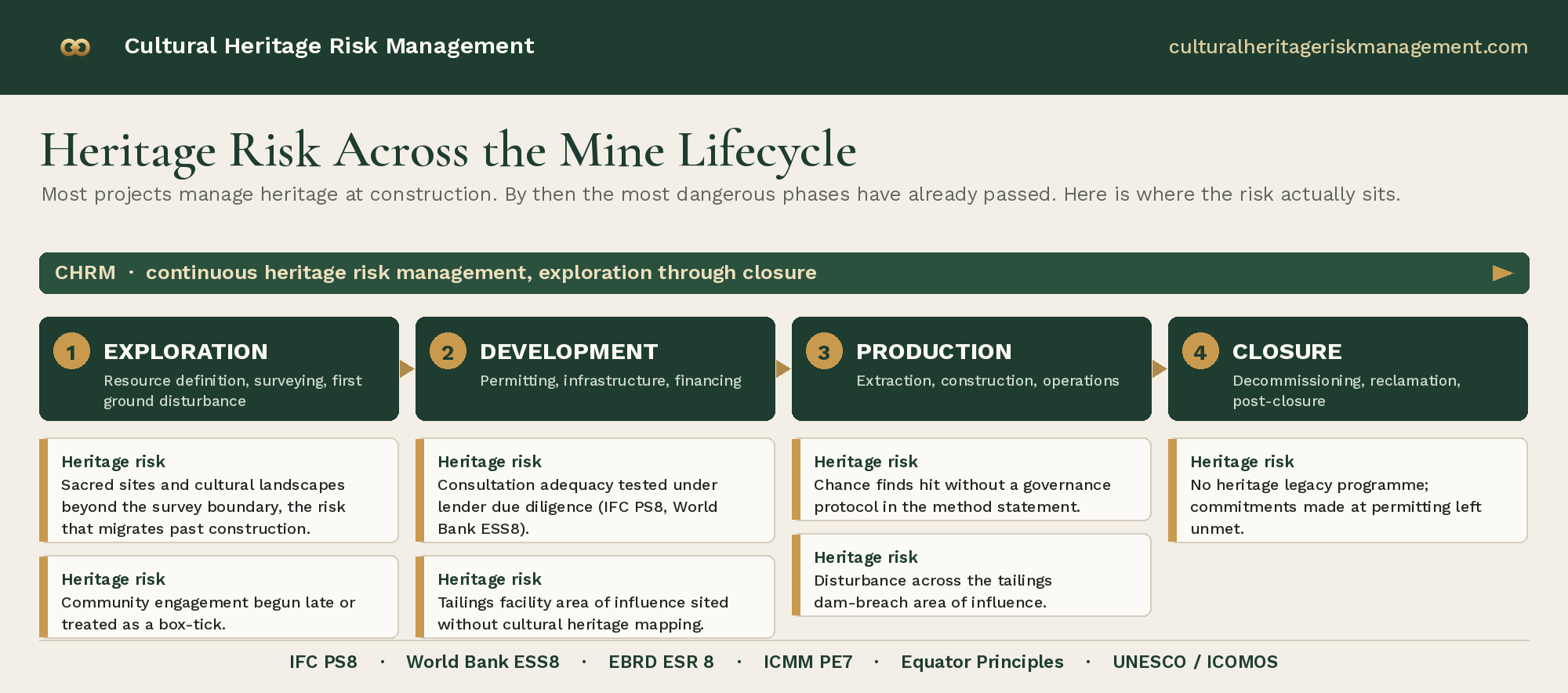
1. Late consultation failure with heritage authorities and affected communities
Heritage law almost everywhere requires genuine consultation with regulators and with Indigenous and local communities before ground is disturbed. When that consultation is treated as a box-check rather than real engagement, the result is a formal objection, a regulator intervention and a hold at exactly the point you can least afford one, when you are mobilising. Consultation adequacy is not measured by the number of letters sent. It is measured by the quality of the engagement.
2. Undisclosed sacred sites and cultural landscapes in the area of influence
A Phase I survey identifies archaeological resources within the direct impact footprint. It does not identify sacred sites, cultural landscapes or culturally significant viewsheds that extend beyond the survey boundary. For critical mineral projects especially, the gap between the archaeological survey boundary and the living cultural landscape is where the biggest stoppages originate. The site is permitted, the risk did not disappear, it migrated.
3. Construction-phase chance finds without a governance protocol
Ground disturbance uncovers the unexpected. Without a pre-agreed chance-find procedure built into the contractor's method statement and safe systems of work, the sequence is predictable: work stops, nobody knows who calls whom, the authority arrives before your heritage specialist does, and you lose days, sometimes weeks, that were not in the programme. A chance-find procedure is not a document. It is a live governance tool that sits inside your construction control framework.
4. Tailings facility area of influence unmapped for cultural heritage
The area of influence of a tailings facility, defined by the modelled inundation path in the event of dam failure, routinely contains archaeological sites, sacred sites, historic structures and community heritage assets that are never mapped, because they fall outside the mine footprint. The Global Industry Standard on Tailings Management now requires social and cultural risk assessment within the dam-breach area of influence. Many operators are still not compliant. If your tailings review does not include cultural heritage mapping, it is incomplete.
5. Mine closure without a heritage legacy programme
Reclamation bonding mandates environmental restoration at closure. It rarely mandates cultural heritage management. So closure plans routinely fail to address the preservation of on-site historic mining structures, the intangible cultural heritage documentation commitments made to communities during permitting, or the cultural landscape commitments embedded in the original management plan. Regulators and communities increasingly pursue post-closure enforcement against operators who made commitments they did not honour. Closure is not the end of your heritage liability, it is a transition point.
The common thread
Managing these risks requires specialist capability embedded across the mine lifecycle, not a compliance report filed at permitting and forgotten. Each of the five surfaces at a different phase, but they share one cause: heritage treated as a document produced once, rather than a risk owned continuously. I provide independent heritage risk management for mining, from exploration through to closure, built around the national regulatory framework wherever the project sits and the international lender standards, including IFC PS8, World Bank ESS8, EBRD ESR 8, the Equator Principles, ICMM Performance Expectation 7, IRMA and the Copper Mark.
If any of the five above are live in your project right now, that is the conversation worth having first.